
Camera lenses
Camera lenses
The soul of your photograph
Your camera is only half the equation. The lens is the other half, often the most important part.
Why? Because the lens determines how you see the world. It determines the depth of field (that beautiful blur behind the subject), the distortion (how lines bend), and the perspective (what you actually capture).
You can have the best camera in the world, but if you have a poor lens, your photos will be mediocre. Conversely, you can have a basic camera with an excellent lens and create real masterpieces.
That’s why serious photographers invest in high-quality lenses. That’s where it really counts.
On this page, you’ll discover eight types of lenses. Each has its own speciality, advantages and limitations. The aim? To help you understand why you might need each one and how to choose them based on your photography style.
A word of advice, you don’t need to buy them all. You should choose the lens that suits your creative vision, then build on that.

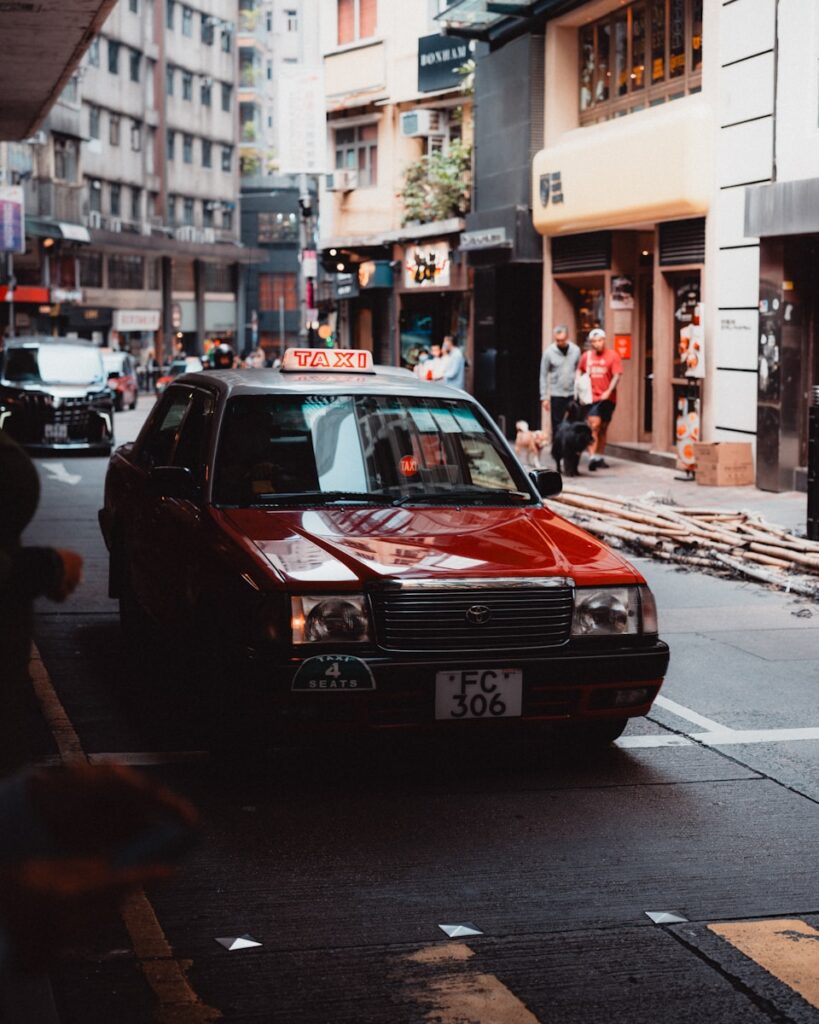
Fixed focal length
What is it? A lens that doesn’t zoom the focal length doesn’t change (e.g. 50mm, 35mm, 85mm). It’s all or nothing.
Theoretical explanation: Fixed focal length lenses generally have a wide aperture (f/1.8, f/1.4, or even f/1.0). This means they let in a huge amount of light. The result: you can shoot in low light, and above all, you get that beautiful bokeh (background blur) that isolates the subject.
Use cases, pros and cons, perfect for portraits (50mm, 85mm), street photography (35mm), and low-light conditions. You get superior optical quality, and they’re lighter and cheaper than a zoom lens. The downside: you have to move to change the framing, and you need to buy several lenses if you want different focal lengths.
Zoom
What is it? A zoom lens — the focal length changes (e.g. 24–70mm, 18–135mm). You can zoom in or out without moving.
Theoretical explanation: Zoom lenses cover a range of focal lengths, giving you enormous flexibility. But be careful: the aperture is often smaller than that of a fixed focal length lens (typically f/4 or f/2.8). Less bokeh, but more practicality.
Use cases, pros and cons, ideal for travel (just one lens), events and family photos. You gain versatility and flexibility. But you sacrifice aperture (less bokeh) and optical quality compared to a fixed focal length lens.
Wide-angle
What is it? A lens that captures a very wide field of view (typically 10–35mm). You can see a huge amount of the scene.
Theoretical explanation: The shorter the focal length, the wider the field of view. Wide-angle lenses distort proportions — straight lines become curved. It’s creative, but it takes some getting to grips with.
Uses, pros and cons: Spectacular landscapes, architecture, property photography, travel. You capture a vast amount and create unique perspectives. But the distortion can be difficult to control, and it’s not very flattering for portraits (it makes faces look wider).
Ultra-wide angle
What is it? An even more extreme wide-angle lens (7–15mm). You capture almost everything around you.
Theoretical explanation: Same concept as a wide-angle lens, but taken to the extreme. Distortion is very pronounced — you can even get a ‘barrel’ effect. Ultra-creative, but requires skill.
Uses, pros and cons: Interior architecture, property photography, epic landscapes, creative photography. You capture an extremely wide view and it’s very creative. But the distortion is pronounced, it’s less versatile, and can quickly become a gimmick.
Telephoto lens
What is it? A lens that brings distant subjects closer (typically 70mm+, often 200–400mm). You shoot from a distance as if you were right up close.
Theoretical explanation: The longer the focal length, the closer you bring the subject. It also compresses the depth of field, creating a beautiful blurred effect in the background.
Uses, pros and cons: Wildlife, sport, long-distance portraiture, astrophotography. You bring subjects closer and create a beautiful compression. Downsides: very heavy, expensive, difficult to hold steady, reduced field of view.
Macro
What is it? A specialised lens for shooting extreme close-ups (insects, flowers, fine details). The reproduction ratio is very close to 1:1 (life-size).
Theoretical explanation: You see tiny details as if they were enormous. But the depth of field becomes extremely shallow — requiring precision.
Uses, advantages and disadvantages: Insects, flowers, textured details, product photography. You reveal the hidden beauty of the world. Downsides: very difficult to master, slow to use, expensive, requires additional equipment (tripod, lighting).
Fish-eye
What is it? An extreme ultra-wide-angle lens (8–15mm) that creates a distinctive barrel-shaped effect, the distortion is intentional and dramatic.
Technical explanation: Captures a 170–180° field of view with pronounced distortion. Straight lines become curved. Creative by default.
Use cases, pros and cons: Creative photography, sports action, vlogging, extreme landscapes. You automatically create creativity. Downsides: extreme distortion, can quickly become a gimmick, not very versatile, expensive.
Standard/versatile lens (24–70mm)
What is it? A zoom lens covering the ‘standard’ focal length range (24mm to 70mm). This is the range used in 80% of situations.
Theoretical explanation: Covers everything from a gentle wide-angle (24mm) to a close-up portrait (70mm). Not specialised in any particular area, but capable in all. It’s the universal all-rounder.
Uses, pros and cons: Portraits, moderate landscapes, reportage, street photography, travel. Extremely versatile and excellent value for money. Downsides: not specialised (less bokeh than a prime lens), average aperture, heavier than a prime lens.
What now?
Have you got the hang of the different lenses? Great! Now find out how to choose the right lens for your specific camera (Canon, Fujifilm, Sony), or check out our blog for practical guides and real-world reviews.
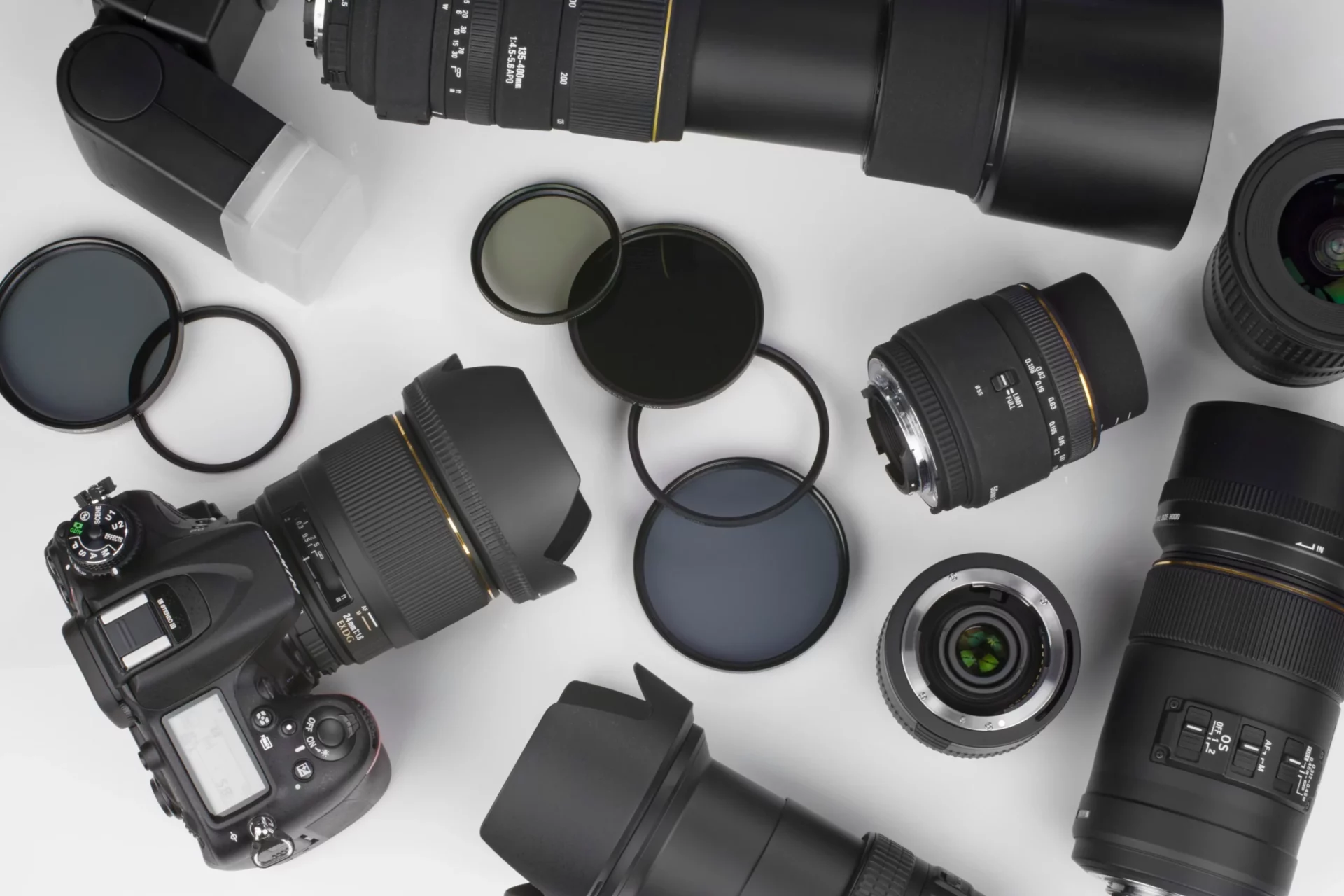
Accessories
Filters, tripods, flashes: discover the tools that can boost your photographic creativity
Blog
Practical guides, comparisons, user reviews and discover the best spots for photography